
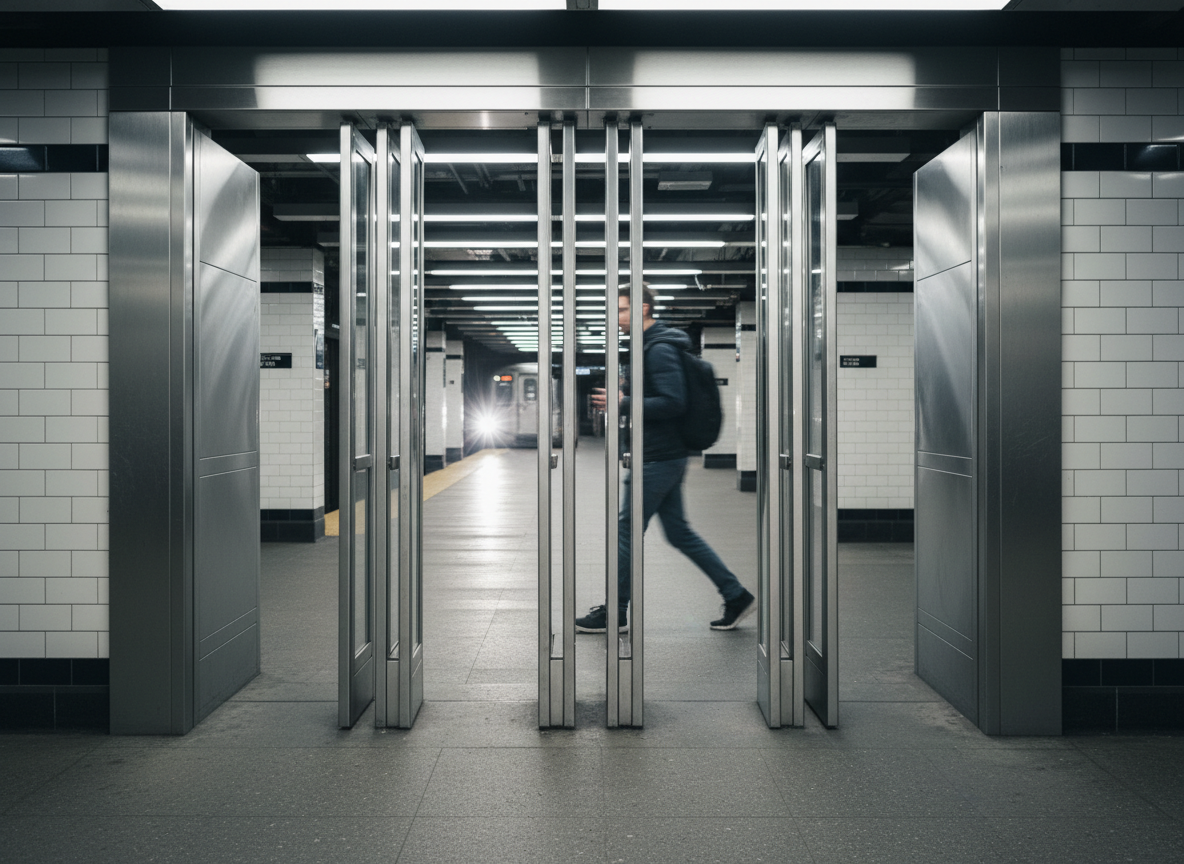
Governor Hochul and the MTA announced on October 7 that the first 20 subway stations fitted with new fare gates saw fare evasion drop by an average of 35% over roughly the past year. At two stations, Hoyt-Schermerhorn in Brooklyn and Nostrand Avenue, the drop was over 70%. That’s the headline number, and it’s a good one. But the detail that actually matters for anyone running a transit payment or fare infrastructure program is buried a layer down: this wasn’t one gate design tested at 20 stations. It was three different vendors’ gates, installed side by side, generating real performance data in a live system before the MTA committed to a bigger contract.
The pilot put Cubic (the company behind OMNY), Conduent, and a Korean firm called S Traffic into the same 20-station set, and the results split clearly. Cubic’s installations, including the two standout stations, posted the strongest numbers. Conduent also showed real gains. S Traffic came in more modest. Now the MTA is moving to a 50-station expansion, structured as two contracts the three companies will compete for, with an eventual target of 150 of the system’s busiest stations. In other words, the pilot wasn’t a proof-of-concept exercise before the real procurement. It was the real procurement, just run in public, on live riders, with the results doing the evaluating instead of a paper scoring matrix.
That’s a more honest way to pick a long-term fare infrastructure vendor than most agencies manage, and it’s also a more expensive one. Running three vendors’ hardware in parallel at 20 working stations means paying for three competing installations before knowing which one wins the next round, plus the integration and maintenance overhead of supporting all three during the test window. Most agencies can’t or won’t absorb that cost, which is exactly why so many fare system RFPs get decided on vendor demos and reference calls instead of live operating data. The MTA had the capital plan room to do it differently here, and the resulting data, evasion rates by station, by vendor, over a sustained period, is a much stronger basis for a $1.1 billion commitment than anything a vendor could present in a conference room.
The other piece worth sitting with is what the gates are actually designed to fix. The redesign swaps the rotating-arm turnstile, essentially unchanged since the 1990s, for tall sliding double doors with motion sensors. That’s the first real turnstile redesign in this system in three decades, which tells you something about how long physical fare infrastructure tends to sit untouched even while the payment layer on top of it, MetroCard to OMNY, keeps evolving. But MTA chair and CEO Janno Lieber has been explicit that the bigger problem isn’t the turnstiles people jump. It’s the exit gates, which he’s called the “superhighway of fare evasion” and which the agency says account for more than half of all subway fare evasion. Entry turnstile-jumping is the visible, photographable version of the problem. Exit gates propped open or walked through backward are the quieter one, and apparently the larger one. Subway evasion overall sits around 10% systemwide; on buses, the MTA puts non-payment at closer to half of all riders, a reminder that fare gate hardware is solving a subway-specific slice of a much bigger revenue problem.
None of this is really a hardware story. It’s a program built around sequencing: pilot three vendors concurrently to get comparative performance data, use that data to structure the next contract instead of a new round of proposals, and target the physical retrofit at the part of the system (exit paths, not entry turnstiles) that the agency’s own fare-evasion analysis says actually matters. Rolling that out station by station, from Brooklyn to the Bronx to Queens, each with its own structural quirks, ADA compliance needs, and construction logistics, is the unglamorous work that makes or breaks whether a fare gate program actually hits 150 stations or stalls out at 40. The $100 million a year in protected fare revenue the governor’s office is citing only shows up if that execution holds.
I’ve been watching a few agencies run procurement this way lately, letting a live pilot do the vendor evaluation instead of a paper one, and I think it deserves more attention than it gets. If you’re working through a fare system RFP or a hardware refresh and have run into the same build-versus-buy-the-data tradeoff, I’d be glad to compare notes.
Leave a Reply